
Opened in 1806 the Portico Library https://www.theportico.org.uk/ was funded and supported by 400 initial subscribers all of them well to do men. Women didn’t get a look-in until 1870 with the influence of the Married Women’s Property Act. The first committee envisioned a place which would hold a collection of books, journals and newspapers for the edification of its members and also provide them with a relaxing lunch venue. The Portico, as well as being a fine library has always had an excellent cafe.
Early members and those who sat on the library’s committee numbered amongst them some world famous names. There was Peter Mark Roget of thesaurus fame, and other members included John Dalton and numerous renowned authors, scientists, future Prime Ministers and wealthy industrialists. Like many old established institutions in Britain, the Portico is engaged in an examination of its connections to empire building, colonisation and the slave trade. No question that these were sources of money that funded the library and its book collection reflects this history. However, its members also included some radical abolitionists and anti-poverty campaigners.
When I landed in Manchester again four years ago (after 39 years away), I needed a quiet place to write. I did a tour of some of the libraries in the centre of Manchester seeking that perfect spot where I’d be able to sit through a day and quietly get words on to paper. The Portico’s reading room proved to be perfect for my needs. I became a member of the library and in the past year have also been volunteering one day a week which is bringing me into closer contact with the books.
The Portico Library is a membership library, but it is open to the public who can enjoy its atmosphere and its cafe. The library gained charitable status in 2017 and now has the goal of re-occupying the entire building, taking back the ground floor which has been rented out since the 1920s when the library was short of funds.
Members of the Portico have access to its collection of books numbering more than 25,000, mostly 19th century, but with some books much older.
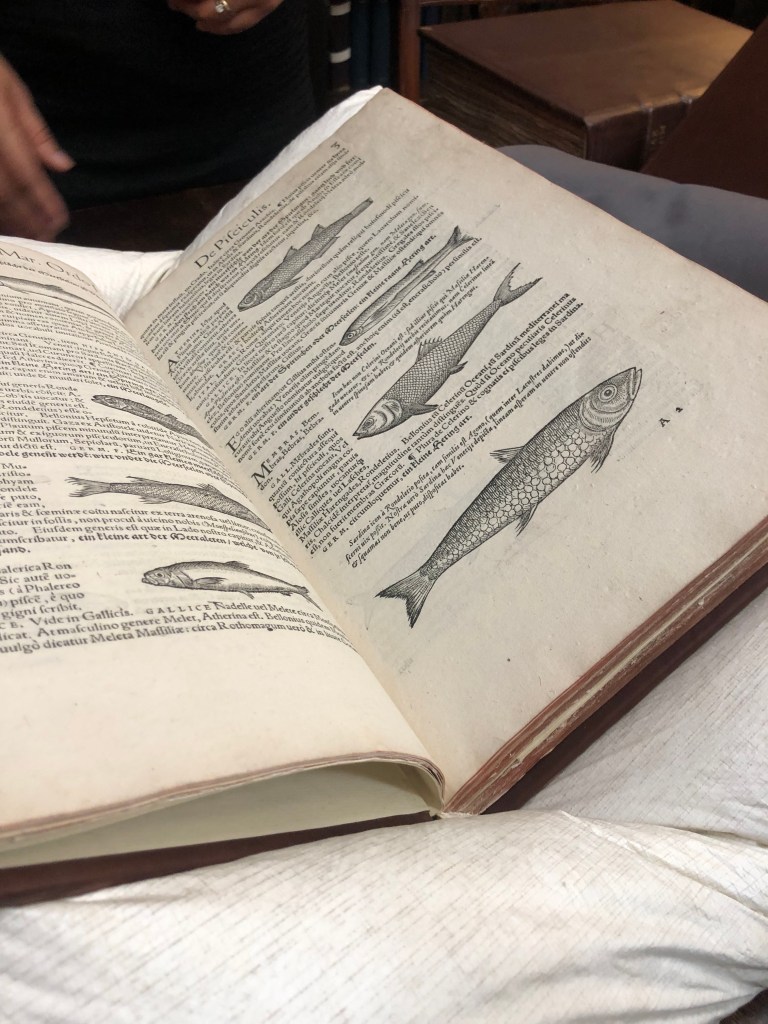
Here is the oldest book in the collection, Historiae Animalium by Conrad Gesner, It is written in Latin and includes many stunning illustrations of animal species. It was published in 1551. There are two volumes which were discovered lying in an extreme state of disrepair, water damaged, in the attic of the building in the late twentieth century. The books were restored and rebound in 1999.

#porticolibrary, #oldbooks, #16thcenturybooks, #19thcenturybooks
 Pam Galloway