
Have you ever heard of “mauveine measles”? Likely not. I certainly hadn’t until I came across it in accounts of the rapid uptake in the use of newly synthesised purple dye in 1850s and 60s. It is not, in fact, an illness.

You will be familiar with the notion that purple has historically been the colour exclusively worn by royalty or clerics. The reason for this was because it was so expensive to make purple dye from the mucus of a sea snail found in the Mediterranean. It’s reported that this “Tyrian purple” was first made in Tyre (in what is now Lebanon) and that in 1stcentury CE a pound of the dye cost as much as half a Roman soldier’s annual salary. This all changed when, in 1856 a young chemistry student named William Perkin discovered, quite accidentally, a way to synthesise a purple dye. He’d actually been trying to make quinine to treat malaria when he noticed a purple solution emerge from his mixings. He tested the effect of this unexpected colour on a piece of fabric and when it came out purple he quickly patented this first synthetically produced purple which he called mauveine. A craze for purple clothing took off and soon the label “mauveine measles” was being used to describe how the fashion statement was spreading through Britain.
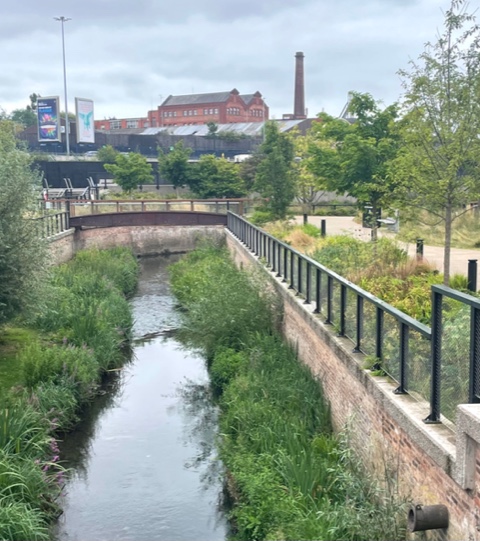
I’ve learned all this after a Ramblers http://ramblers.org.uk walk yesterday took me to Manchester’s newest park (first in a hundred years), Mayfield Park. A site manager gave us a brief history of the site and told of its industrial past, in particular it having been where a man called Thomas Hoyle set up a dye works in 1856. We were told that it was Thomas who had first worked out how to make a purple dye from a plant, rubia tinctorum or European Madder. The park has been planted with many different purple plants to honour Thomas’s legacy as an innovator in making purple fabric available to ordinary folks not just the elite. Despite extensive searches I’ve not been able to find much at all about Thomas’s discovery and have to come down in favour of Perkin as the man who brought the colour purple to the masses.
Thomas Hoyle was, however a progressive employer at his dye-works and notably built a bathhouse for his workers. In 2019 when the site was being excavated for development the remains of the bathhouse were found. The tiles used in the pools were in remarkable condition and many have been saved and will be used in further building on the Mayfield Park site.
I haven’t written any poems about dye works but here’s one I wrote for my first manuscript (for my MFA, 24 years ago!!) about my family history through 19th and 20th centuries and Industrial Revolution stories from that time.
Queen of Red Clay
Some irreverent wag, looking at her
standing…broad wooden sceptre in
her hand and her yellow turban on her head
might call her the Sultana of Edom or
the Queen of red clay…
Elihu Burrit 1868
She stands statuesque
her turbanned head, her thin garments
spattered with clay she works into bricks,
slaps into moulds, her hands
lift and turn these inedible loaves.
Pale-skinned girls
blood drained by the weight of wet clay
they carry on their heads
might be her pages.
if only their court was gold-painted,
scented by spiced meat searing over open fires,
lady and attendants dressed in silk.
Instead they smell the blaze of kilns
push each common day toward week’s end
and a few pennies for the gin palace
Beyond the factory wall
men are building monuments to labour.
No ceremony, no kings or queens cut ribbons.
Just brick on brick, slate roofs and chimneys
stacked against a raddled sky..
https://www.soci.org/about-us/history/notable-scientists-and-inventors/william-perkin
 Pam Galloway