
As any writer, I wish to have people read my work. Musings here have been randomly inspired pieces. I’ve therefore decided to dip into my books, published in Canada, to talk about some of the poems and stories behind them. Parallel Lines and Passing Stranger each present slices of my life so are, in part, poetic memoirs. I used family stories to throw light on my family history and added in research into life in 19th century Manchester for some poems.
Queen of red clay
I read this poem at the recent event “One City, Many Voices” at Central Library, Manchester. Organized by the Manchester Literary and Philosophical Society (Lit and Phil) and the Muslim Arts and Culture Festival (MacFest). It brought together four poets with different connections to Manchester, born here or from another part of UK, migrated here and, for me, returned after 40 years away. Multi-generational and with different styles both in writing and presenting, the event was a stimulating peek into poetry in Manchester.
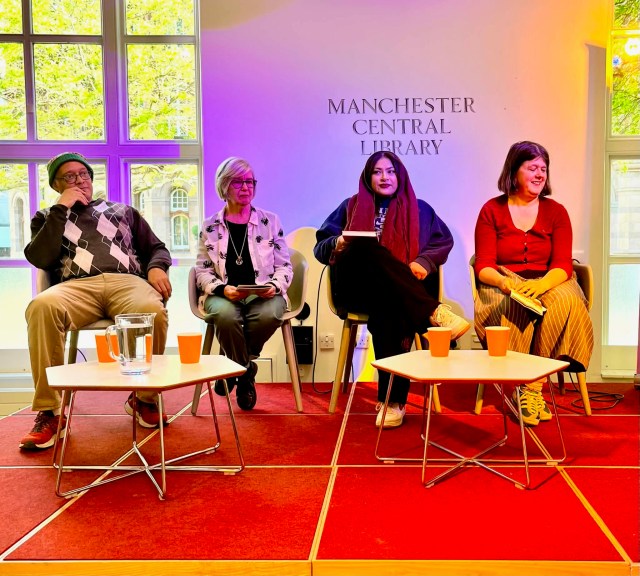
Peter Kalu, naseema bee and
Nora Blascok read from their work alongside me.
This poem, Queen of red clay, was inspired after reading accounts of factory and mill workers, this one about a woman working at a brick factory described by Elihu Burritt (American consular agent in Birmingham, noted pacifist and anti-slavery activist) who started out as a blacksmith himself. He undoubtedly knew something of what he wrote.
There were numerous brick factories in Manchester though Burritt’s observations were written after his time spent living in the Back Country. To me, his description of the conditions in the factory and his focus on the women who toiled in suffocating heat, leant dignity to the workers. I tried to give some sense of the living and working conditions for the working class at the time my ancestors lived and worked in Ancoats and Longsight. My cousin, Margaret Willis, has researched the genealogy of the Galloways extensively and found family members worked, as might be expected, in various jobs connected to the cotton trade, which boomed in the 19th century. Canal work, mill and factory work… .
Queen of red clay
Some irreverent wag, looking at her
standing…broad wooden sceptre in
her hand and her yellow turban on her head
might call her the Sultana of Edom or
the Queen of red clay…
Elihu Burrit 1868
She stands statuesque
her turbaned head, her thin garments
spattered with clay she works into bricks,
slaps into moulds, her hands
lift and turn these inedible loaves.
Pale-skinned girls
blood drained by the weight of wet clay
they carry on their heads
might be her pages
if only their court was gold-painted,
scented by spiced meat searing over open fires,
lady and attendants dressed in silk.
Instead they smell the blaze of kilns
push each common day toward week’s end
and a few pennies for the gin palace.
Beyond the factory wall
men are building monuments to labour.
No ceremony, no kings or queens cut ribbons.
Just brick on brick, slate roofs and chimneys
stacked against a raddled sky.
First published: TickleAce (Summer ’96) then in Parallel Lines (2006)
Science and Industry Museum Manchester
Working Class Movement Library Manchester
The People’s History Museum
Books

