The Sun Inn and its poets — what a discovery for me!

A problem for me, a cause for contemplation (and even at times, irritation) when I returned to Manchester after a 40 year absence was how much iambic pentameter and rhyming poetry I heard at the city’s open mics. Hadn’t such regular form long since become “old-school”, out-dated and not interesting? It was all of that in Canada. Well, here’s the story of my long overdue education.

In April of this year I saw a call for anyone interested in learning more of Manchester’s literary heritage to attend a meeting about the “Sun Inn Poets”. Keen for this opportunity, I turned up at Manchester Cathedral https://manchestercathedral.org

Tom Branfoot (@thesuninnpoets)Yorkshire poet and, currently, writer-in-residence at the cathedral called the meeting to garner support for his National Lottery Heritage funded project named for the Sun Inn Poets. He wanted to revive awareness of the group who met in the 1840s at the Sun Inn and who adopted its name. This group had contributed so much to Manchester’s literary history but their legacy had long been forgotten. Tom wanted to revive interest in their work and to stimulate a 21st century group of writers and artists to create a body of new, radical works: poetry, song, visual art, whatever people brought to the group would be welcomed and applauded.

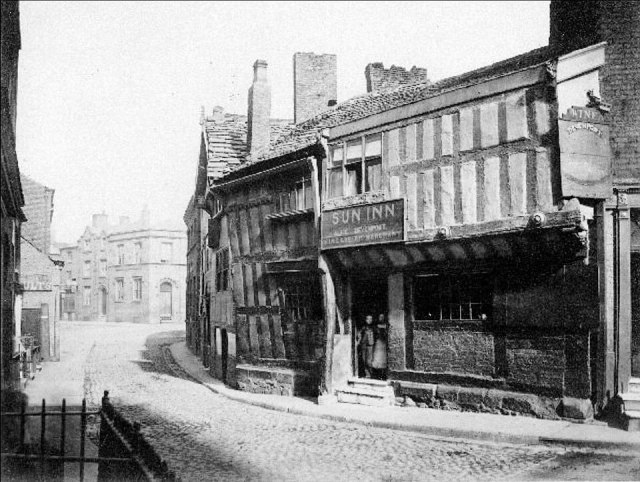
First, some background. The Sun Inn was an ancient (even in the 19th century) timber-framed hostelry which stood opposite the gates of Chetham’s College (est.: 1653) on Long Millgate in Manchester. It was known as Poets’ Corner after it became the meeting place for a group of mostly working class writers, The Sun Inn Poets.

In the early 19th century, Manchester was not known as a significant cultural centre. It’s importance and fame, of course, grew from its role in the Industrial Revolution which of course had its sinister side. People toiled in mills and factories for little reward and in dreadful living and working conditions. How could these conditions not spur on radical politics? When literacy among the working class was low, their complaints against injustice, their demands to be heard, seen and rewarded with improved conditions were often made loudly through spoken word and song. Those who could read and write, distributed their words as broadsheets or songsheets.

And the Sun Inn, for a few years (through the 1840s) became the meeting place for a group to recite their poetry, sing ballads and gather in a spirit of solidarity. Founders and major players in the group were John Critchley Price, John Rogerson and Robert Rose (self-styled as “the Bard of Colour”). Radical poems were not all they wrote. Their interest in poetry ranged broadly through numerous forms and styles. And though reports at the time speak almost entirely of the male members of the group, there were in fact a number of women who went along to the Saturday evening sessions at the Sun. One was Isabella Varley (Mrs George Linnaeus Banks) whose most famous novel The Manchester Man has become one of the “must-read” books documenting Manchester in the nineteenth century. Other women writers attending included Isabella Caulton, Eliza Battye and Eliza Craven Green.

Reading the poetry and songs of the time, sometimes from original documents held at Chetham’s Library https://library.chethams.com learning what poetry meant to working class people in Manchester has given me a genuine appreciation of how much poetry across the North has always favoured rhyming forms, traditional rhythms and song. This made recitation easier, helped memory to spread the word and their popularity lives on in the open mics in our cafes and pubs.

Sun Inn Poets circa 2026 includes a large group of poets and artists across an age spectrum (20s-70s) who are enthusiastically taking part in educational sessions e.g. the Chartist movement and their poetry and song; exploration of archives held at Manchester Cathedral and at Chetham’s as well as writing new works to allow the reputation of the 19th century group to rise again — as the sun always does.

https://www.the87press.co.uk/shop/p/volatile

https://www.eventbrite.co.uk/e/the-sun-inn-poets-reading-open-mic-tickets-2002998784283

https://manchesterhistory.net/manchester/gone/poetscorner.html
Musings plus… .

As any writer, I wish to have people read my work. Musings here have been randomly inspired pieces. I’ve therefore decided to dip into my books, published in Canada, to talk about some of the poems and stories behind them. Parallel Lines and Passing Stranger each present slices of my life so are, in part, poetic memoirs. I used family stories to throw light on my family history and added in research into life in 19th century Manchester for some poems.

Queen of red clay

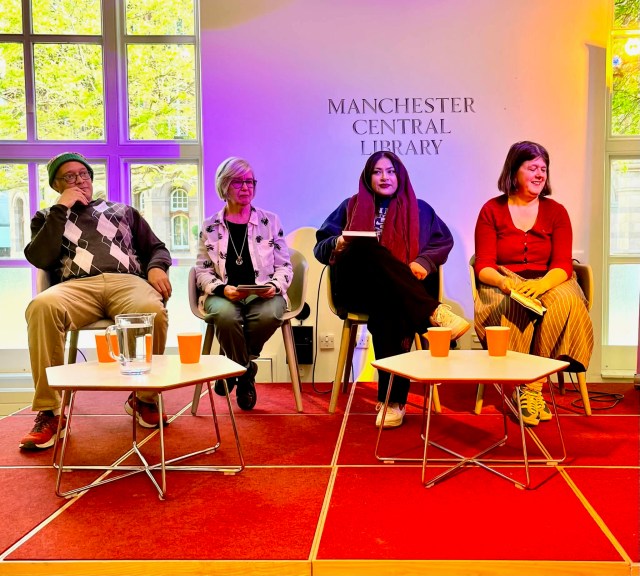
I read this poem at the recent event “One City, Many Voices” at Central Library, Manchester. Organized by the Manchester Literary and Philosophical Society (Lit and Phil) and the Muslim Arts and Culture Festival (MacFest). It brought together four poets with different connections to Manchester, born here or from another part of UK, migrated here and, for me, returned after 40 years away. Multi-generational and with different styles both in writing and presenting, the event was a stimulating peek into poetry in Manchester.

Peter Kalu, naseema bee and
Nora Blascok read from their work alongside me.

This poem, Queen of red clay, was inspired after reading accounts of factory and mill workers, this one about a woman working at a brick factory described by Elihu Burritt (American consular agent in Birmingham, noted pacifist and anti-slavery activist) who started out as a blacksmith himself. He undoubtedly knew something of what he wrote.

There were numerous brick factories in Manchester though Burritt’s observations were written after his time spent living in the Back Country. To me, his description of the conditions in the factory and his focus on the women who toiled in suffocating heat, leant dignity to the workers. I tried to give some sense of the living and working conditions for the working class at the time my ancestors lived and worked in Ancoats and Longsight. My cousin, Margaret Willis, has researched the genealogy of the Galloways extensively and found family members worked, as might be expected, in various jobs connected to the cotton trade, which boomed in the 19th century. Canal work, mill and factory work… .

Queen of red clay

Some irreverent wag, looking at her
standing…broad wooden sceptre in
her hand and her yellow turban on her head
might call her the Sultana of Edom or
the Queen of red clay…

Elihu Burrit 1868


She stands statuesque
her turbaned head, her thin garments
spattered with clay she works into bricks,
slaps into moulds, her hands
lift and turn these inedible loaves.

Pale-skinned girls
blood drained by the weight of wet clay
they carry on their heads
might be her pages

if only their court was gold-painted,
scented by spiced meat searing over open fires,
lady and attendants dressed in silk.
Instead they smell the blaze of kilns
push each common day toward week’s end
and a few pennies for the gin palace.

Beyond the factory wall
men are building monuments to labour.
No ceremony, no kings or queens cut ribbons.
Just brick on brick, slate roofs and chimneys
stacked against a raddled sky.

First published: TickleAce (Summer ’96) then in Parallel Lines (2006)

Science and Industry Museum Manchester

Working Class Movement Library Manchester

The People’s History Museum

Books


“My Library”– the Portico. An Update

Walk along Moseley St. beside the tram tracks in the centre of Manchester and where it crosses Charlotte St. you will see an impressive building which you’ll recognize as the Bank pub. Many people don’t look further. But if you take a turn at the corner you’ll find an unassuming green door. Look up and see “The Portico Library 1806”. Enter and a narrow staircase will lead you up to a room which I promise will provide you a definite “Wow” response.

It’s been seven years now since I came back to live here, to support Mum in her final years and since I decided to become a member of the Portico. Apart from being a stunning example of Manchester’s 19th century architecture and a pleasure to step inside, it’s Reading Room provided me a quiet space to write. In these years I’ve begun to refer to the Portico as “my library”.

Now, I’m excited to be involved in the Portico’s Reunite project which will see the library again occupy all three floors of the building with an £11 million revisioning of its space.

This significant juncture in its history is being supported by a Grant from the National Lottery Commission as well as a vigorous fund-raising campaign.

See theportico.org.uk for how you can add your support.

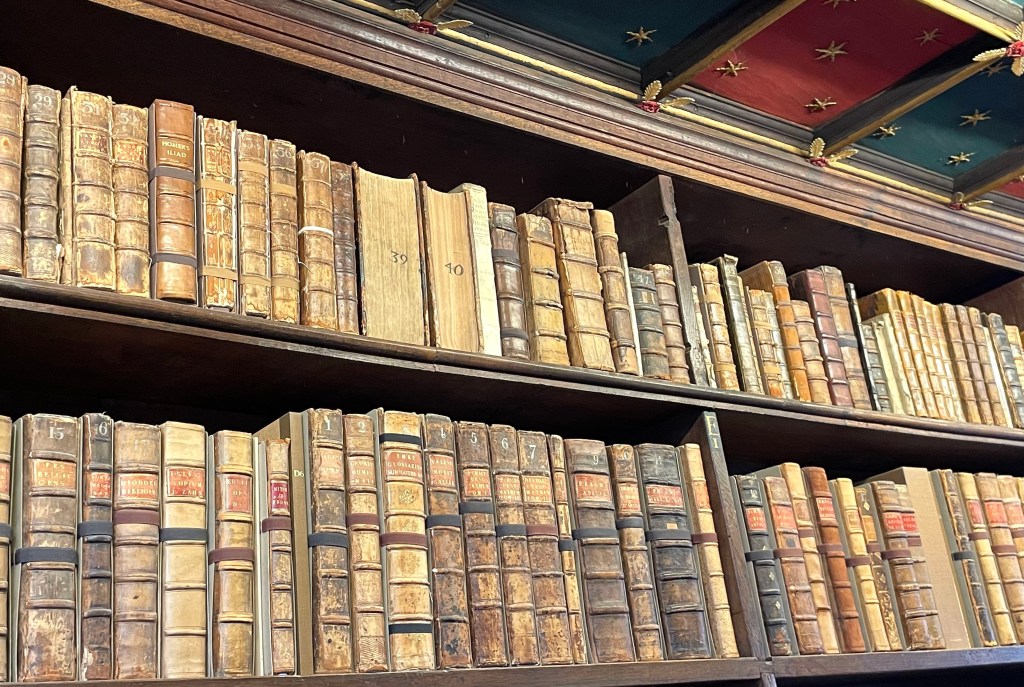
The Portico achieves so much in its limited top floor space being not only a library with 25,000+ centuries-old books but also an inspirational art gallery and a fine cafe fast becoming recognized as one of Manchester’s best lunch spots. 

For its current exhibition “Everything and Nothing” the library staff ventured into the building’s attic where its archive is stored. What they found began to shape a consideration of what it is that makes a library and this is at the heart of the exhibition. Visitor’s are asked to contribute their ideas and to write a message to be placed in a time capsule to be opened in 2076.

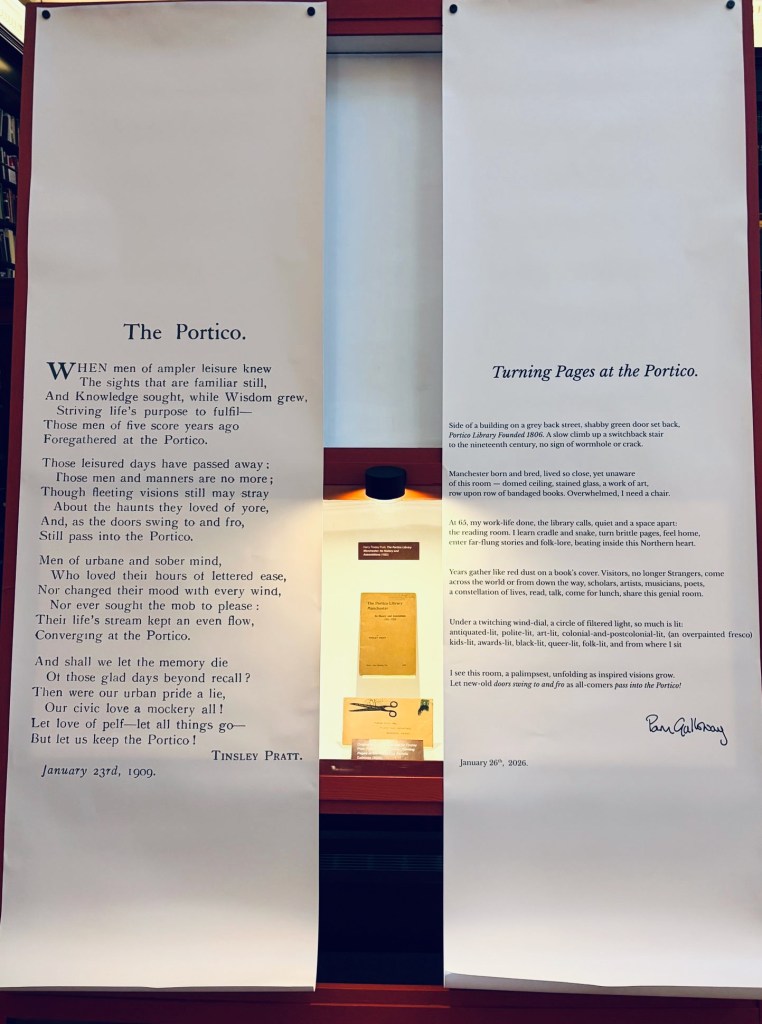
For my contribution at this significant juncture in the library’s history, the library’s staff commissioned a poem from me to respond to the only other known poem to have been published, “The Portico” by Tinsley Pratt (1909). What an honour!


On display with “The Portico” by Tinsley Pratt:

#theportico.org.uk; #poetry; #porticoreunited; #antiquarianlibraries #antiquarianbooks