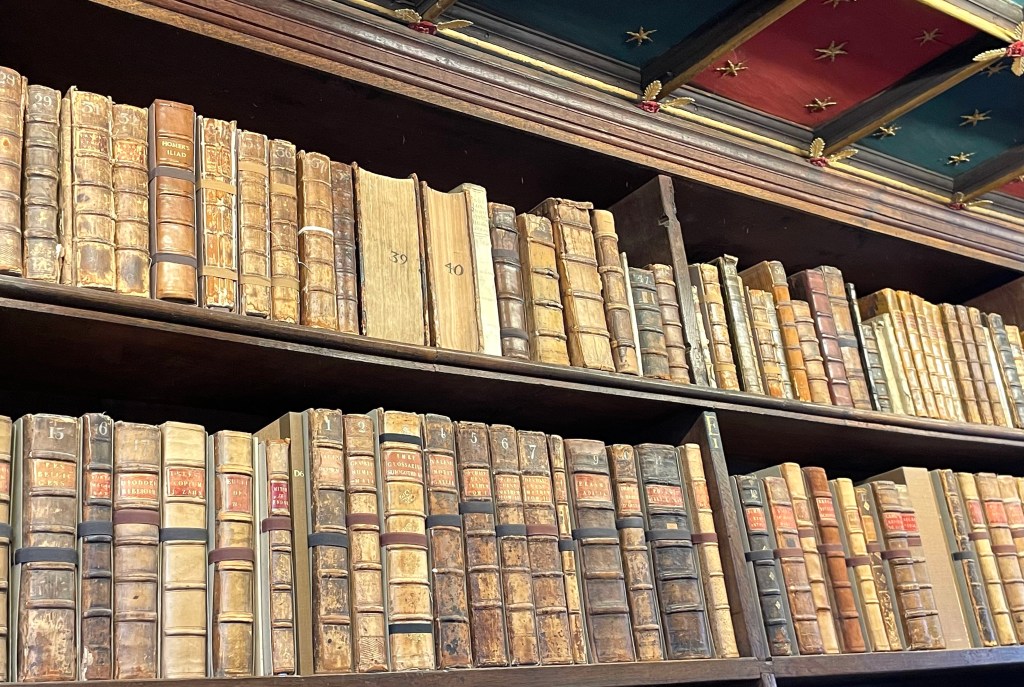
“My Library”– the Portico. An Update

Walk along Moseley St. beside the tram tracks in the centre of Manchester and where it crosses Charlotte St. you will see an impressive building which you’ll recognize as the Bank pub. Many people don’t look further. But if you take a turn at the corner you’ll find an unassuming green door. Look up and see “The Portico Library 1806”. Enter and a narrow staircase will lead you up to a room which I promise will provide you a definite “Wow” response.

It’s been seven years now since I came back to live here, to support Mum in her final years and since I decided to become a member of the Portico. Apart from being a stunning example of Manchester’s 19th century architecture and a pleasure to step inside, it’s Reading Room provided me a quiet space to write. In these years I’ve begun to refer to the Portico as “my library”.

Now, I’m excited to be involved in the Portico’s Reunite project which will see the library again occupy all three floors of the building with an £11 million revisioning of its space.

This significant juncture in its history is being supported by a Grant from the National Lottery Commission as well as a vigorous fund-raising campaign.

See theportico.org.uk for how you can add your support.

The Portico achieves so much in its limited top floor space being not only a library with 25,000+ centuries-old books but also an inspirational art gallery and a fine cafe fast becoming recognized as one of Manchester’s best lunch spots. 

For its current exhibition “Everything and Nothing” the library staff ventured into the building’s attic where its archive is stored. What they found began to shape a consideration of what it is that makes a library and this is at the heart of the exhibition. Visitor’s are asked to contribute their ideas and to write a message to be placed in a time capsule to be opened in 2076.

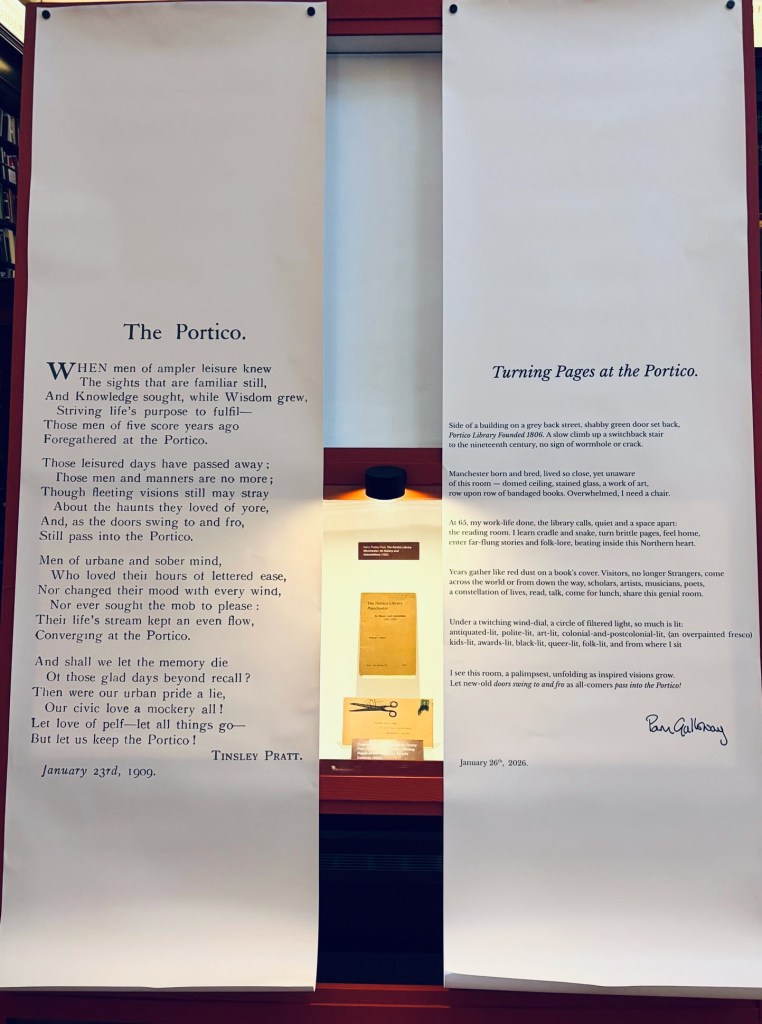
For my contribution at this significant juncture in the library’s history, the library’s staff commissioned a poem from me to respond to the only other known poem to have been published, “The Portico” by Tinsley Pratt (1909). What an honour!


On display with “The Portico” by Tinsley Pratt:
#theportico.org.uk; #poetry; #porticoreunited; #antiquarianlibraries #antiquarianbooks
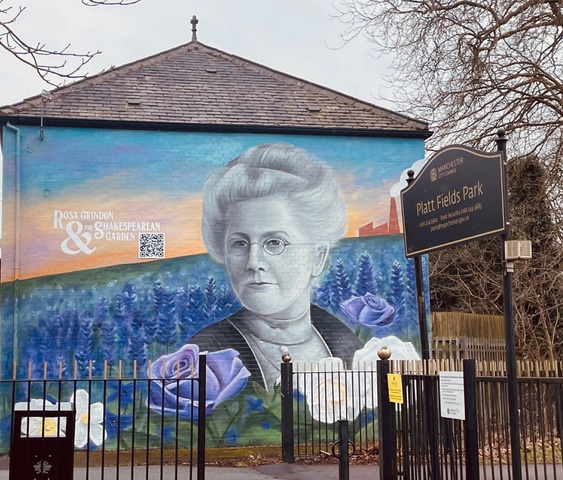
Rosa Grindon and the Shakespearean Garden

A Shakespearean Garden! I had never heard of such a thing until I came across a group of gardeners busy at work in Platt Fields Park, Manchester. I was there with some of my walking group, the Manchester and Salford Ramblers.  https://www.manchesterandsalfordramblers.org.uk/ I hadn’t been in the park since I was a child. I was born in Longsight close to the city centre in a terrace of small dwellings ultimately tagged “slum housing”. Needless to say there were no trees on the streets where I lived but my mother knew that children needed to be in nature and breathe relatively fresh air. We had regular days out to a few of Manchester’s big parks and Platt Fields was one. 

Recently, we Ramblers were on a “slow walk” in the park, allowing us to take in landmarks and history. First, there was Platt Hall itself, an 18th century grand house which has been part of the Manchester Art Gallery since the 1920s. For many years, 1947-2017, it held the Gallery of Costume. For now it’s closed and its exact future role is to be decided but it will remain part of the Manchester Art Gallery. 

We strolled past the boating lake, no boats in February, but I counted many water birds: Mute Swans, Tufted Ducks, moorhens, coots, gulls. I had no memory of the big pond or its boats! It was right after this that I caught sight of a mural that filled the side of a building at the Fallowfield Brow end of the park. A portrait of a woman painted in bright shades of purple, green and white. It was a bit of a way from the pond and I announced to everyone that I’d go ahead and find out who this woman was. I was thrilled to discover she was a Manchester Rosa (my daughter’s name). The group soon followed me and we began to learn about Rosa Grindon. 

Rosa Elverson Grindon (1848-1923) came from simple beginnings, born in a small village in Derbyshire. She became a Shakespearean scholar who challenged many of the primarily male-dominated interpretations of women in the Bard’s plays. She was the first woman to be invited to lecture at the Stratford Festival and also ran the Manchester Literary Ladies Society, holding meetings in her back garden. She bequeathed money for the Shakespeare window in Manchester’s Central Library. Rosa was a philanthropist and a suffragist, with the goal of votes for women very much in her heart. Like her husband Leo, a botanist, she loved plants and in 1922, the 300th anniversary of Shakespeare’s death, she developed the Shakespearean Garden in the park. It was planted with the 175 plants named in Shakespeare’s plays and poetry. The garden fell into serious neglect over many years of limited budgets for Manchester’s parks. Restoration began in 2021 by an enthusiastic group of gardeners who still tend the garden weekly. There’s an open invitation for interested people to join them.  https://www.facebook.com/ShakespeareanGarden And for more on Platt Fields Park: https://friendsofplattfields.org.uk

The mural was painted in 2024 by Ethan Lemon who has created a visually stunning tribute to Rosa in its bold purple, white and green – colours of the suffrage movement. Ethan Lemon is an established studio and mural artist with an impressive and international list of clients. His murals are in many spots around Manchester. https://www.ethanlemonart.com

Here are a couple of examples of Shakespeare’s words on flowers:

I know a bank where the wild thyme blows,
Where oxlips and the nodding violet grows,
Quite over-canopied with luscious woodbine,
With sweet musk-roses and with eglantine:
There sleeps Titania sometime of the night,
Lull’d in these flowers with dances and delight.
A Midsummer Night’s Dream (2.1.255-60)

Here’s flowers for you;
Hot lavender, mints, savoury, marjoram;
The marigold, that goes to bed wi’ the sun
And with him rises weeping: these are flowers
Of middle summer, and I think they are given
To men of middle age.
The Winter’s Tale (4.4.122-7)

[Final note: in an ironic twist, as I researched Shakespearean Gardens I discovered there has been one in Vancouver BC (where I lived for 40 years) since 1916! So much for my literary awareness. I also found a link to the Canadian Women’s Press Club (1909)  Who’s who at the 3d International Congress of Women, Rosa Grindon listed as having attended. Did she also travel west I wonder?]