Musings plus… .

As any writer, I wish to have people read my work. Musings here have been randomly inspired pieces. I’ve therefore decided to dip into my books, published in Canada, to talk about some of the poems and stories behind them. Parallel Lines and Passing Stranger each present slices of my life so are, in part, poetic memoirs. I used family stories to throw light on my family history and added in research into life in 19th century Manchester for some poems.

Queen of red clay

I read this poem at the recent event “One City, Many Voices” at Central Library, Manchester. Organized by the Manchester Literary and Philosophical Society (Lit and Phil) and the Muslim Arts and Culture Festival (MacFest). It brought together four poets with different connections to Manchester, born here or from another part of UK, migrated here and, for me, returned after 40 years away. Multi-generational and with different styles both in writing and presenting, the event was a stimulating peek into poetry in Manchester.
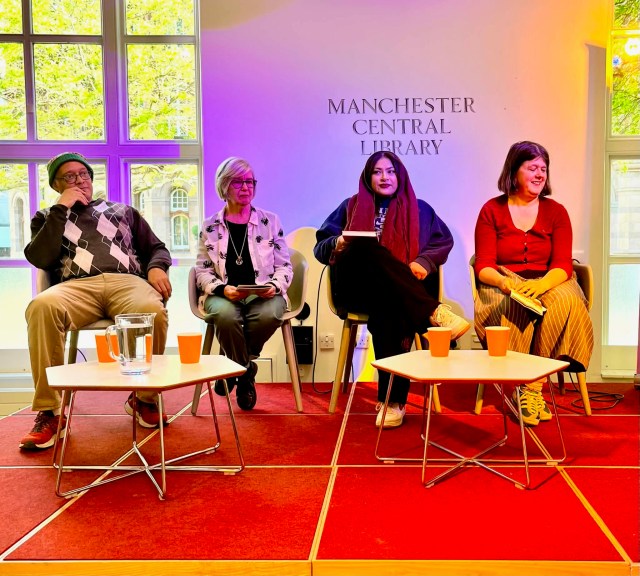
Peter Kalu, naseema bee and
Nora Blascok read from their work alongside me.

This poem, Queen of red clay, was inspired after reading accounts of factory and mill workers, this one about a woman working at a brick factory described by Elihu Burritt (American consular agent in Birmingham, noted pacifist and anti-slavery activist) who started out as a blacksmith himself. He undoubtedly knew something of what he wrote.

There were numerous brick factories in Manchester though Burritt’s observations were written after his time spent living in the Back Country. To me, his description of the conditions in the factory and his focus on the women who toiled in suffocating heat, leant dignity to the workers. I tried to give some sense of the living and working conditions for the working class at the time my ancestors lived and worked in Ancoats and Longsight. My cousin, Margaret Willis, has researched the genealogy of the Galloways extensively and found family members worked, as might be expected, in various jobs connected to the cotton trade, which boomed in the 19th century. Canal work, mill and factory work… .

Queen of red clay

Some irreverent wag, looking at her
standing…broad wooden sceptre in
her hand and her yellow turban on her head
might call her the Sultana of Edom or
the Queen of red clay…

Elihu Burrit 1868


She stands statuesque
her turbaned head, her thin garments
spattered with clay she works into bricks,
slaps into moulds, her hands
lift and turn these inedible loaves.

Pale-skinned girls
blood drained by the weight of wet clay
they carry on their heads
might be her pages

if only their court was gold-painted,
scented by spiced meat searing over open fires,
lady and attendants dressed in silk.
Instead they smell the blaze of kilns
push each common day toward week’s end
and a few pennies for the gin palace.

Beyond the factory wall
men are building monuments to labour.
No ceremony, no kings or queens cut ribbons.
Just brick on brick, slate roofs and chimneys
stacked against a raddled sky.

First published: TickleAce (Summer ’96) then in Parallel Lines (2006)

Science and Industry Museum Manchester

Working Class Movement Library Manchester

The People’s History Museum

Books


Our Old House

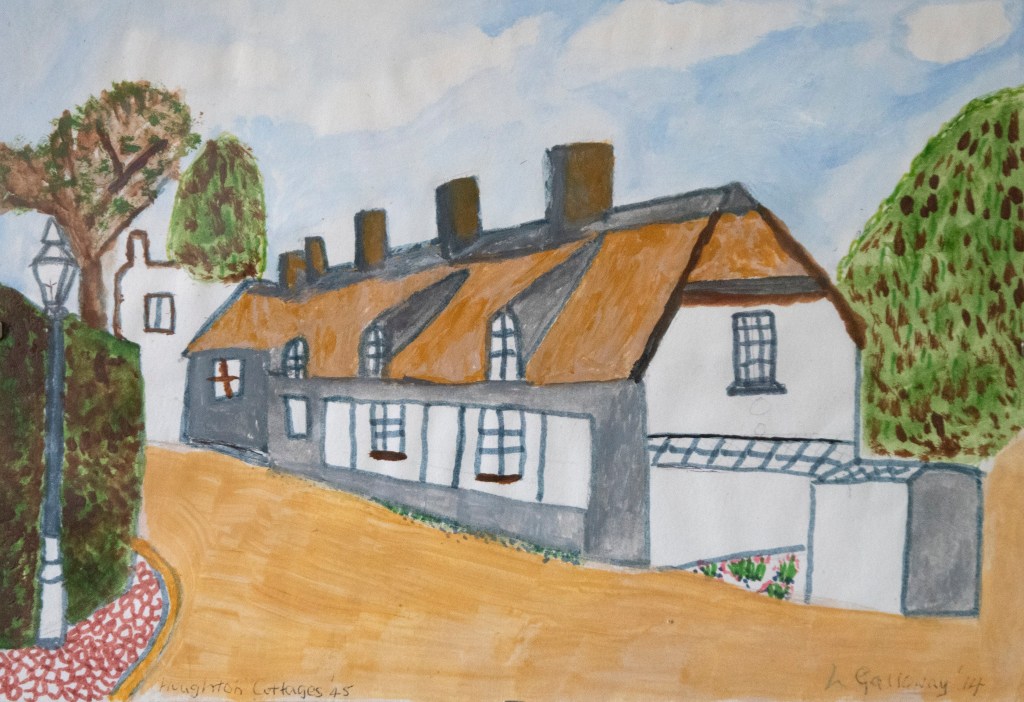
The current image has no alternative text. The file name is: mumspaintingcottages2020.jpg

Mum always said the day she and Dad moved into the house in Torridon Walk they thought they’d landed in Paradise. As an eight year old I guess I didn’t appreciate the full joy but it was definitely new, strange and huge. I recall running up the wide stairs to my very own bedroom, stopping on the way to use the upstairs, indoor toilet and splashing water into the bath just to watch it pool there under its own power.

A three-bedroomed council “semi” was at least four times bigger than our two-up-two down in Longsight’s slum clearance district. And that’s not counting the garden. Just to have a garden fulfilled a dream neither of my parents had imagined coming true. Front and back, grass, trees and rich, black soil waiting for Dad’s efforts at self-sufficiency. Well, at least in the vegetable department. Potatoes, onions, cabbage, carrots, lettuce, radish, beetroots and eventually tomatoes when he’d gained enough know-how. I was his garden help with the planting and inevitably the weeding. Mum chose berry bushes: blackcurrant, redcurrant, raspberries, gooseberries with the native brambles providing a harvest she turned into pies, jams and jellies and yes, I was kitchen assistant too. 

In the sixties, Wythenshawe was in the countryside. The house was only a mile from Ringway airport with a single runway and newly built control tower and surrounding it were farms and country lanes which became our playground. There were fields right up alongside the house and, as I write, the one closest to the house is still intact, gone wild. Not farmed any longer and no doubt waiting for the next airport expansion. It will happen.

Mum and Dad lived in that house together for fifty-five years and for sixty-six years of marriage. The house gradually emptied of family chatter, comings and goings and gatherings over the next nine years when Mum lived there by herself. She died last May, two weeks before her 95th birthday. The house is now waiting on its new family as its sale just completed. 65 years after our family moved in there. That’s an awful lot of memories. And as the cliche has it: if only the walls could talk. 

Here’s another one: it’s only bricks and mortar but something lives in those memories and so there is sadness in closing the front gate behind me for the last time.

Illustration by Lilian Galloway. Here’s one of here poems about living in the place she loved.

Urban Thoughts


The countryside at my back door
The willow herbs, trees and fields
I’ve come to love them more and more
Winds that whistle, crows that caw.

Soon I fear, with noise and roar
This scene of peaceful interlude
Will be extinct and lost forever mpre
Because of human greed.

The things I love will all be lost
Swallowed. as by a mighty. frost
Trees and fields will be no more
When I look out from my back door.

Lilian Galloway

Walking into writing.

Another in my very occasional musings (note to self: get here more often!)

One step then another. Ignore the steady rain on this typical Manchester morning and lift eyes to the skeletal tops of trees. Listen. A robin, a blue-tit and the increasingly familiar cry of parakeets, now regarded as native birds in the UK. Beside the trail, neon green shoots push through the undergrowth; crocus and daffodils reach up, building confidence. I’m in the present moment as my yoga teacher instructs, attending to What Is and not to What If?

I’ve learned a lot about walking in the last few years. Practicalities like the importance of appropriate clothing. Being wet on the outside is of no concern to me today in my efficient waterproofs. A stick gives me more stability in mud or when climbing a slope. And I’m valuing the friendships I’m making when I go out on guided walks along canals, rivers, parks and out to the edge of the moors with my group, the Manchester and Salford Ramblers. People who love to be out and walking are friendly and open and I’ve had many great conversations. My mostly weekend walks are now between six and nine miles. Walks close to home are more relaxed affairs than they ever were when all I was thinking of was the dog’s need for exercise, my need to get back home for a cuppa and my own “programme” was conducted at the soulless gym. The pandemic cured me of my unhappy relationship with treadmills and weight machines. I now spend time in “my park” (Wythenshawe) and along “my river” (the Mersey) absorbing the rewards of fresh air, the entertainment of squirrels skittering in and around the trees and the sight of grebes, herons or cormorants. The river path connects me back to the other river close to my heart, the Mighty Fraser in B.C. where I have walked for many years and where many poems began to take shape. I get that bonus here too. As I walk, breathe and clear my mind words start to come through and I speak to nature as my audience. Sometimes I take out my phone, set the Voice Memo going so I can recall my thoughts when I get back to my desk.

These two poems evolved from my walking words.

Minding the Fraser Foreshore Trail

Stop. Before this tree,
lift my gaze into its lattice
of branches. They stretch, flex,
reach fingers to their neighbours
and somewhere inside this tangle of green,
scatter of leaves and needles, a bird sings.

I have promised myself, I will
stop, listen to the invisible, the hidden
bird that pipes an alert
mind birdsong,
mind rugged bark
mind branches, needles and leaves
mind this forest trail.

Some days

Along the lower trail that leads to the pond,
plants push through a chaos of growth 
fed by the moist and richly-rotted soil along the creek.
This is where Tara forages for chamomile, she shows me
how it persists all winter in ragged patches beneath tough grasses,
their coarse blades bent to the rain.

Where the path rises and bends, cottonwoods 
spread branches to make a ceiling, in summer
their leaves shut out the sky.
Now, their broad trunks are spaced 
between alders, make a silent room, a space outside
judgment where I can listen 
to the resounding toll of endings.

Inside this monochromed box, 
shut-down, so little light 
seeping through the slats this January morning, 
I will allow no imaginings of a new day’s new blooms,
light caught within them and held, an hour, 
a week, a season. This morning,
there will be no stirrings
of change to ring the pure bell
 that signals all beginnings.

#walking #nature #poetry #hiking #writing